Archivo del Autor: Pablo Aretxabala

Avatar de Desconocido

Acerca de Pablo Aretxabala

Pablo Aretxabala (www.linkedin.com/in/pabloaretxabala)

The day of the basque fatherland: Aberri Eguna

That photo is from the web www.naziogunea.net

That photo is from the web http://www.naziogunea.net

For the catholics, today is the Easter Sunday and for basques nationalists is also their day of the Basque Fatherland (Aberri Eguna in Basque language)

That’s not a day like the 4th of July for the northamerican people or the 14th of July for the french citizens, even is like the 11th of september (Diada) for the catalonian people. Aberri Eguna is not like those others days of the fatherland from different countries or comunities, because the Aberri Eguna is not accepted for all the basque citizens as their fatherland’s day.

Only nationalist parties have celebrated this day that was «invented» by  Sabino Arana, the founder of PNV (the most important basque nationalist party)

Today, Ibarretxe, the President of the Basque Country, and member of PNV, has said in reference to the terrorist organization ETA: «could die for a fatherland but couldn’t kill for it»

I suppose he is trying to discredit the terrorism of ETA but, in my opinion, only one thing is clear: Ibarretxe thinks that the fatherland is more important than the life, and this is a terrible affirmation.

In this question I have the same opinion than Seneca, «Patria mea totus hic mundus est» (My fatherland is the whole world), or than Mario Benedetti who wrotte the poem «Patria es Humanidad» (The Fatherland is Mankind)

Any Fatherland worth a life.
Drugs: the dilema betwen chase or legislate

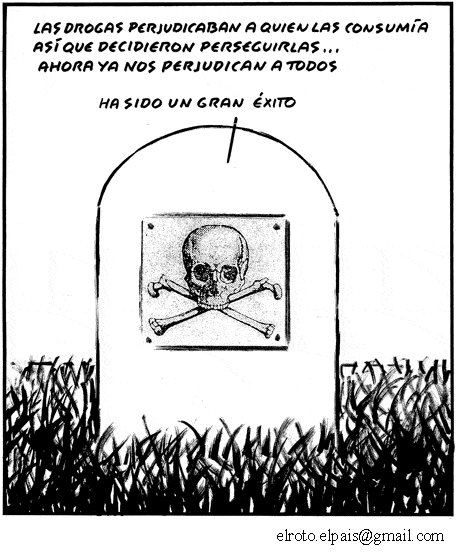
el-roto«Drugs were damaging the one who was consuming them, so they decided to chase them…

Now already are damaging to all of us

It’s been a great success»

Legislation of drugs could save UK £14bn, says satudy

The regulated legalisation of drugs would have major benefits for taxpayers, victims of crime, local communities and the criminal justice system, according to the first comprehensive comparison between the cost-effectiveness of legalisation and prohibition. The authors of the report, which is due to be published today, suggest that a legalised, regulated market could save the country around £14bn.

The orgasm of Zapatero with Obama

My friend Jose A. del Moral has posted a very smart twit today: «Spain is such a minor country that its president has an orgasm after having a 45 min. interview with Mr. Obama«

This is the photo of the «historic moment»:

ronald_reagan_felipe_gonzalez

Opps, sorry, this is President Gonzalez with Reagan… now is the good one

bush-gonzalez

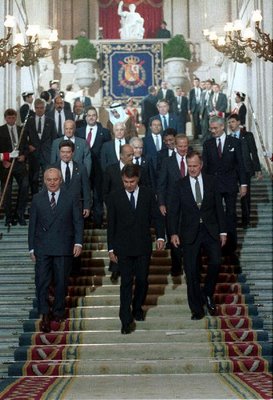
Oh shit! this is President Gonzalez again, with Bush father… I’m sure the next one is what we are looking for…

WL008793

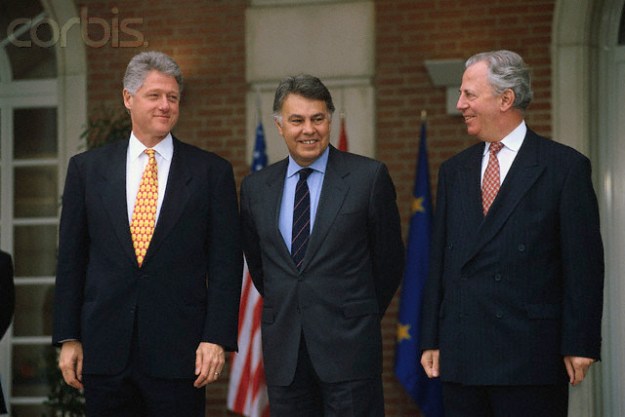
Can you belive it? President Gonzalez again, with a third President of the United States, President Clinton!!! My Good! I thought only Zapatero has a photo with a President of the United States but… anyway, lets continue the search

clinton-aznar1

I think I know of something this moustache, but I’m almost sure that he is not Zapatero… I’m really tired, is posible that all the Presidents of Spain have had a photo with all the Presidents of the United States?

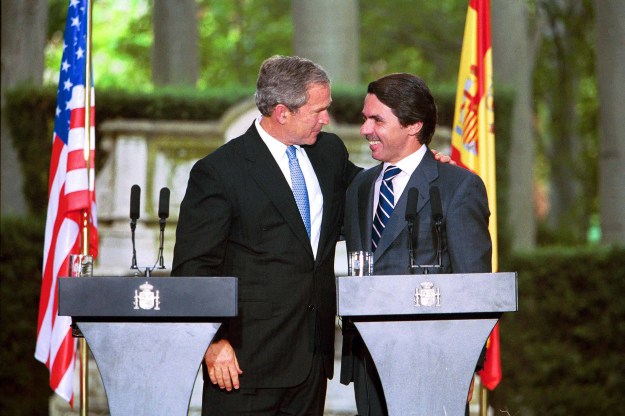
aznar-y-bush

Ok, it’s enough for me, I search for a last photo and I hope this is the one with Zapatero and Obama

obama-zapateroWell, President Zapatero, you already have your photo… could you please start to govern your country? Thanks

The health of the financial institutions in the Basque Country

In Basque Country (including la CAV and Navarra), we have important financial institutions of three types: banks (BBVA and Banco Gipuzcoano), Savings Banks (BBK, Vital, Kutxa and Caja Navarra) and Credit Unions (Caja Laboral, Ipar Kutxa and Caja Rural)

Till now, the financial institutions in Spain and specially in Basque Country have a solid performance to tackle the global crisis.

In fact, Basque Country has a «AAA» from Standard & Poor’s meanwhile Spain has only an «AA+», being the first case in Europe that a region of a estate has more rating than the estate.

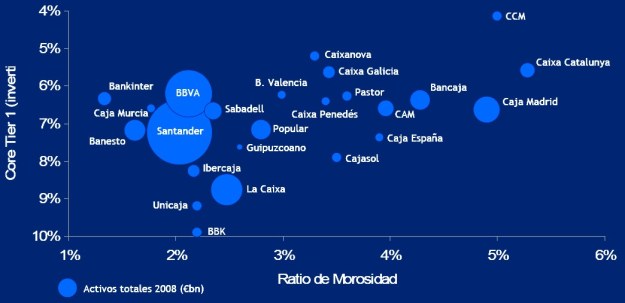
In this image, you can see the good position of three of theese financial institutions, with facts from JP Morgan

coretier1_morosidad1

(I saw it in: Hay cajas y cajas: Euskadi is different (2). arkimia)

16 edition of Korrika: running in favor of the Euskera, the basque language

Korrika is the Basque name of a Country-wide walkathon organised by the Coordinator for Basque Language and Literacy/Learning (AEK) in support of the Basque language. The objective of the event is to enhance awareness of Basque and raise funds to carry out this work on a daily basis in AEK study centres.

The first Korrika took place in 1980 and the course ran from Oñati (Gipuzkoa) to Bilbao (Bizkaia). Since then, the walkathon has become one of the Basque Country’s major events in terms of number of participants. Over the past 28 years 15 korrikas have been held.

This year the Korrika begun on March 26th in Tutera and will last 11 days non-stop, covering 2000 km throughout the Basque Country. As in previous editions, hundreds of thousands of people of all ages and fitness levels will be taking part.

A hollow baton is carried during the walkathon and exchanges hands at each change of kilometre. Inside there is a message which will not be made public until the Korrika ends on April 5th in Vitoria-Gasteiz, when a well-known Basque personality will read it out loud.

The real face of the new government in the Basque Country

firma-pp-pse1

In the Basque Country, for the first time in 30 years, we are going to have a Governement without the PNV (basque nationalistic party)

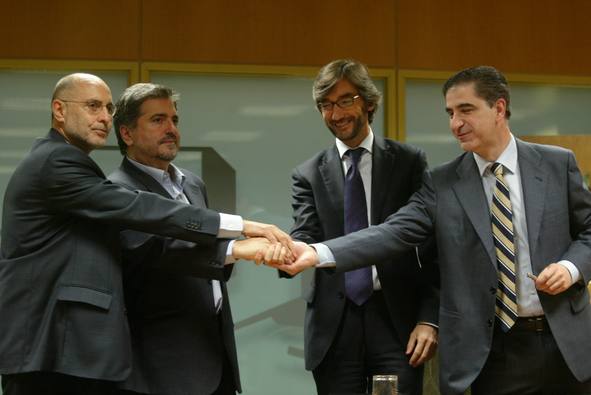
In the left of the photo you can see  the representants of the PSE (Socialist Party) and in the right, the representants of the PP (Conservative Party) in the moment of the agreement por the new governement.

Only by his faces, who of them do you think are the «winners» with this agreement?

First step to take advantage from the crisis

That crisis is going to be longer and deeper than any other before nowadays, but that doesn’t meant that we are at the end of the world.

We can blame on someone or we can hope a miracle; neither of both will work anyway.

If we really want to take advantage from the crisis we must start to adapt to the circumstances: as soon as we begin, better we’ll be when the crisis ends.

In my opinion there are two specially important tips about this for the companies:

  • Your company has much less posibilities to survive if you hold the division betwen property and workers. Property has the capital, the money, but the persons who work in the company has the knowledge, and both will be absolutly necessaries in the future.
  • Our companies, the property,the executives, the workers, everybody, must learn to live and to work with less; must learn to expend less, to reuse more, to be much more efficient… and we must learnt it as soon as possible.

This is only the first step, but if you don’t take it, you will not arrive anywhere

(Traducción automática al castellano)

A leap in the dark?

«No crisis like this has a simple or single cause, but as a nation we borrowed too much and let our financial system take on irresponsible levels of risk. Those decisions have caused enormous suffering, and much of the damage has fallen on ordinary Americans and small-business owners who were careful and responsible. This is fundamentally unfair, and Americans are justifiably angry and frustrated.» (Mr. Geithner, the U.S. Treasury secretary, today)

I agree, and I think those words can be said also about the rest of the citizens of the world.

So, with this kind of analisys, what must we do? By the moment Obama’s Administration have decided to dedicate 1 billion dollars to guaranty private investors who will be willing to buy «toxic assets»: Wall Street reacts with euphoria to this plan. It’s understandable, it will be a real good deal: if the investment rise his value, the benefits are for the private investors, but if the investment low down, the taxpayer will take charge of the disaster.

We are really solving the situation or running faster to the abyss? The time will say, but it makes me suspicious.

(Si prefieres, en castellano)

What would you be willing to do for save your children’s future?

My Family (Cristina, Asier and Jon Ander)

My Family (Cristina, Asier and Jon Ander)

This combined crisis that we are living could be, if we want, a great oportunity to save our planet and the future of our children.

Humans have a lot of faults and one of the most dangerous is our lack of long term vision and of overall view.

I think all the important decisions about economy, about growth, about energetic resources, etc should pass the following two simple questions to be accepted:

  • The decision, is able to be aplied for everybody all over the world?
  • The decision, is really sustainable in time? Are we sure that have not inconvenients in long term?

Unfortunatelly, our way of life (in the «first world», I mean) has their bases in the inequality and in the thoughtlessness.

We don’t need to appeal to great indicators or special economical theories to realize about the absolut and complete impossibility that the 6.000 millions of persons who inhabit the Earth Planet could live in the same way we do it in the «first world».

We know this perfectly, and we know that our beautiful first world is supported by the extreme poverty of the rest of the humankind, but we (and I include myself) prefer to close our eyes to this unconfortable truth.

There’s no future for this world we have built, I’m sure of it.

I don’t know the solution… but I’m reading a lot of very, very interesting things about «De-growth» (for example in spanish this article in El País or this blog, or in english, the wikipedia) and perhaps…

(Traducción automática al castellano)